The first time my daughter told me she didn’t want me at her school play, I thought she was embarrassed by me.
She was eleven, and lately everything I did seemed to make her uncomfortable.
I waved too enthusiastically when I picked her up from school. I called her “sweetheart” in front of her friends. Once, I brought her forgotten lunch into the classroom, and she barely spoke to me for the rest of the afternoon.
So when she came into the kitchen on a Tuesday evening and announced that I shouldn’t come to Friday’s performance, I tried not to take it personally.
“Are you sure, Lily?” I asked.
She kept her eyes on the refrigerator.
“Yeah. It’s not a big deal.”
“But you’ve been practicing for weeks.”
“I know.”
“I thought you wanted me there.”
She shrugged.
“Things change, Dad.”
I smiled because I didn’t know what else to do.
But after she went upstairs, I stood at the kitchen counter for a long time, staring at the dinner I’d been preparing.
What hurt wasn’t missing the play.
It was realizing that my little girl might be growing into someone who no longer wanted me around.
I had no idea how wrong I was.
It Had Always Been Just the Two of Us
Lily’s mother died when she was four.
For seven years, I’d been the person who packed her lunches, helped with homework, signed permission slips, and sat through every school event.
I wasn’t particularly good at all of it.
I burned pancakes. I forgot picture day twice. And once, I accidentally sent Lily to school wearing two different shoes because I’d been rushing to get us out the door.
But I showed up.
Every parent-teacher meeting. Every birthday party. Every terrible elementary school concert.
I was there.
That was the one thing I promised myself after we lost her mother.
No matter how difficult life became, Lily would never have to look into an audience and wonder whether someone had come for her.
Which made her request about the school play especially painful.
The Ticket in the Trash
On Wednesday evening, I was emptying the kitchen garbage when I noticed a folded piece of yellow paper near the top.
It had Lily’s school logo printed on it.
I pulled it out.
SPRING THEATER NIGHT — ADMIT ONE
The ticket had my name written across the back.
Underneath, in Lily’s handwriting, were the words:
Please don’t give this to Dad.
I read the sentence twice.
Then I unfolded the paper completely.
There was nothing else.
I told myself not to overreact.
Maybe she had written it while upset. Maybe she was worried I’d embarrass her. Maybe there was some perfectly ordinary explanation.
But it was difficult not to feel rejected.
That night, while Lily was brushing her teeth, I stood outside the bathroom and almost asked her about it.
Instead, I walked away.
I didn’t want her to feel guilty for growing up.
A Strange Phone Call
Thursday afternoon, my phone rang while I was at work.
It was Mrs. Bennett, Lily’s drama teacher.
“Mr. Carter? I’m calling about tomorrow’s performance.”
I braced myself.
“Is something wrong?”
“Not exactly. I just wanted to confirm that you’ll be attending.”
I hesitated.
“Lily told me she doesn’t want me there.”
There was a pause.
“She said that?”
“Tuesday night.”
Mrs. Bennett sounded genuinely surprised.
“Well, I don’t want to interfere with anything between you two, but I think you should come.”
“I don’t want to make her uncomfortable.”
“I understand,” she replied. “But trust me. You really should be there.”
Something in her voice made me uneasy.
“Is Lily okay?”
“She’s absolutely fine.”
“Then what’s going on?”
Another pause.
“I think it’s better if you see for yourself.”
Before I could ask another question, she thanked me and ended the call.
I spent the rest of the afternoon distracted.
By the time I got home, I’d decided to ask Lily directly.
But she was sitting at the dining table with a notebook open, looking more nervous than I’d ever seen her before.
When she noticed me, she quickly closed it.
“Everything okay?” I asked.
“Yep.”
“Excited about tomorrow?”
She nodded without looking up.
I wanted to tell her about the phone call.
Instead, I asked whether she wanted spaghetti for dinner.
She said yes.
And that was that.
The Night of the Play
Friday arrived with heavy rain.
Lily left for school early because the cast had an afternoon rehearsal.
Before she walked out the door, she gave me a quick hug.
“Love you, Dad.”
“Love you too.”
Then she hesitated.
“You’re not coming tonight, right?”
My chest tightened.
“If that’s what you want.”
She looked down.
“Okay.”
For a moment, I thought she might say something else.
But she hurried toward the school bus.
At six-thirty that evening, I was sitting on the couch with the television on when my phone buzzed.
A message from Mrs. Bennett.
We’re starting in fifteen minutes. There’s a seat waiting for you.
I stared at the screen.
Then I grabbed my keys.
I wasn’t sure whether I was doing the right thing.
But something told me that if I stayed home, I might regret it.
The Empty Chair in the Front Row
The school auditorium was nearly full when I arrived.
Parents were talking, children were running between the rows, and teachers were trying to get everyone seated.
Mrs. Bennett spotted me near the entrance.
She smiled and motioned for me to follow her.
“Thank you for coming.”
“Does Lily know I’m here?”
“Not yet.”
She led me to the front row.
There was an empty chair near the center aisle.
A small white envelope rested on the seat.
My name was written across the front.
I looked at Mrs. Bennett.
“What’s this?”
“Something Lily asked me to give you.”
Then she disappeared backstage.
I sat down and opened the envelope.
Inside was a handwritten note.
Dad,
I know I told you not to come.
I wasn’t trying to hurt your feelings.
I was scared I’d cry if I saw you before I went onstage.
Please stay until the end.
Love, Lily.
I felt my throat tighten.
Before I could read it again, the auditorium lights dimmed.
The Part I Didn’t Know About
The play began like any other elementary school production.
There were forgotten lines, crooked costumes, and one little boy who waved at his mother every time he walked across the stage.
Lily played a supporting role.
She appeared in three scenes and delivered her lines perfectly.
I clapped every time she came onstage.
Then, just when I thought the performance was finished, Mrs. Bennett stepped in front of the curtain.
“Before we close tonight,” she announced, “our students have prepared a short presentation about the people who inspire them.”
A screen lowered behind her.
One by one, photographs appeared.
A firefighter. A grandmother. A teacher. A nurse.
Each student had written a few sentences about someone they admired.
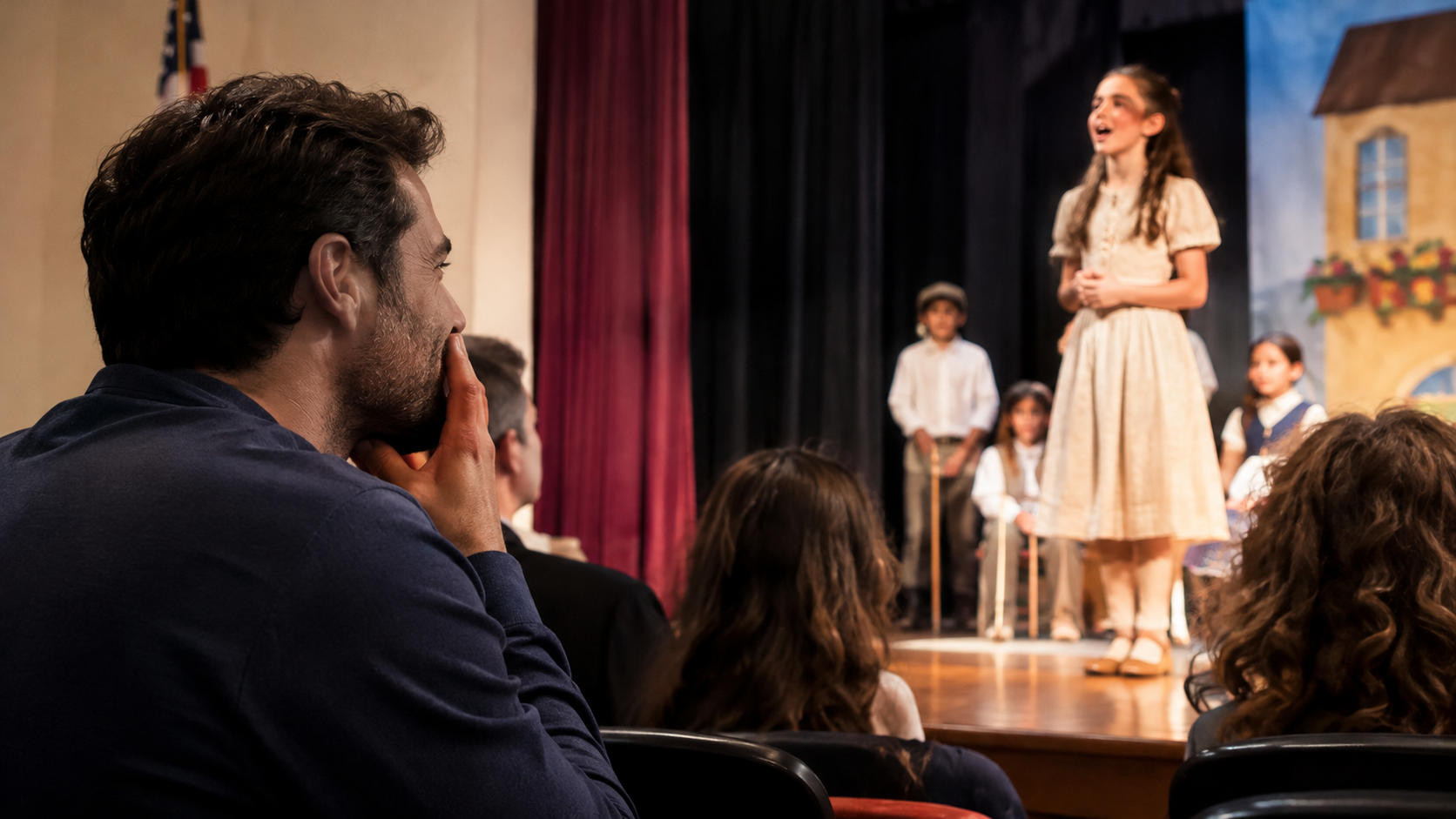
Then Lily walked onto the stage.
She was holding a folded piece of paper.
And behind her, on the screen, appeared a photograph of me.
Not a flattering photograph.
I was asleep on our living room couch, wearing an old sweatshirt, with Lily’s science project balanced on my lap.
I recognized the picture immediately.
She’d taken it last winter after we’d stayed up past midnight building a model of the solar system.
The audience chuckled softly.
Lily unfolded her paper.
“My hero isn’t famous,” she began.
“He’s not an athlete or a movie star. He doesn’t have a fancy job, and sometimes he makes really bad pancakes.”
More laughter.
I smiled.
Then her voice changed.
“When I was four, my mom died. I don’t remember everything about her. But I remember that after she was gone, my dad started doing two people’s jobs.”
The auditorium grew quiet.
“He learned how to braid my hair by watching videos. He went to every school event, even when he was tired. And when I had nightmares, he sat beside my bed until I fell asleep.”
I pressed my fingers against my eyes.
Lily looked down at her paper.
“Sometimes people ask me if I’m sad because I don’t have a mom.”
She paused.
“And I am. I miss her.”
Her voice trembled.
“But I also know how lucky I am.”
She looked toward the audience.
“Because I have a dad who never makes me feel like I’m missing half a family.”
I couldn’t see clearly anymore.
Then she said something I will never forget.
“I didn’t want him to come tonight because I was afraid I’d start crying before I could finish. But I hope he’s here anyway.”
She searched the front row.
When she saw me, her face changed.
For one second, she looked terrified.
Then she smiled.
And I stood up.
What Happened After the Curtain Closed
The audience applauded.
Lily tried to continue, but she was crying now.
She wiped her cheeks with the back of her hand.
“I just wanted to say thank you, Dad.”
That was all she managed.
Mrs. Bennett stepped forward and gently placed a hand on her shoulder.
I was still standing when Lily ran down the steps at the side of the stage.
She crossed the aisle and threw her arms around me.
“I’m sorry I told you not to come,” she whispered.
I hugged her so tightly that she started laughing through her tears.
“Sweetheart, you don’t have to apologize.”
“I didn’t want to ruin the surprise.”
“You didn’t.”
She pulled back.
“Are you crying?”
“Absolutely not.”
“Dad.”
“Fine. A little.”
She laughed again.
Behind us, the audience was still applauding.
But for a moment, I barely noticed anyone else.
The Ticket I Kept
Later that night, after Lily had gone to bed, I took the yellow ticket out of my wallet.
I’d brought it with me, even though I hadn’t needed it to enter.
I looked again at the words she’d written on the back.
Please don’t give this to Dad.
For two days, I’d believed those words meant she didn’t want me around.
Now I understood that she had been trying to keep a surprise.
The next morning, Lily found me sitting at the kitchen table with the ticket, her letter, and the program from the play.
“What are you doing?” she asked.
“Thinking about getting these framed.”
She rolled her eyes.
“Dad, that’s embarrassing.”
I smiled.
“Then I guess some things never change.”
She reached across the table and stole a piece of toast from my plate.
“Can we make pancakes?”
“Sure.”
“The good kind?”
I pretended to be offended.
“There’s another kind?”
She laughed.
And as I stood up to get the mixing bowl, I realized something.
I had spent the entire week worrying that my daughter was growing away from me.
But she had been finding her own way to tell me how much I mattered.
Sometimes the words that hurt us most are only part of a story we haven’t heard all the way through.