Every Sunday, a Woman Left a Grocery Bag Outside Her Neighbor’s Door — Until One Morning, the Bag Came Back
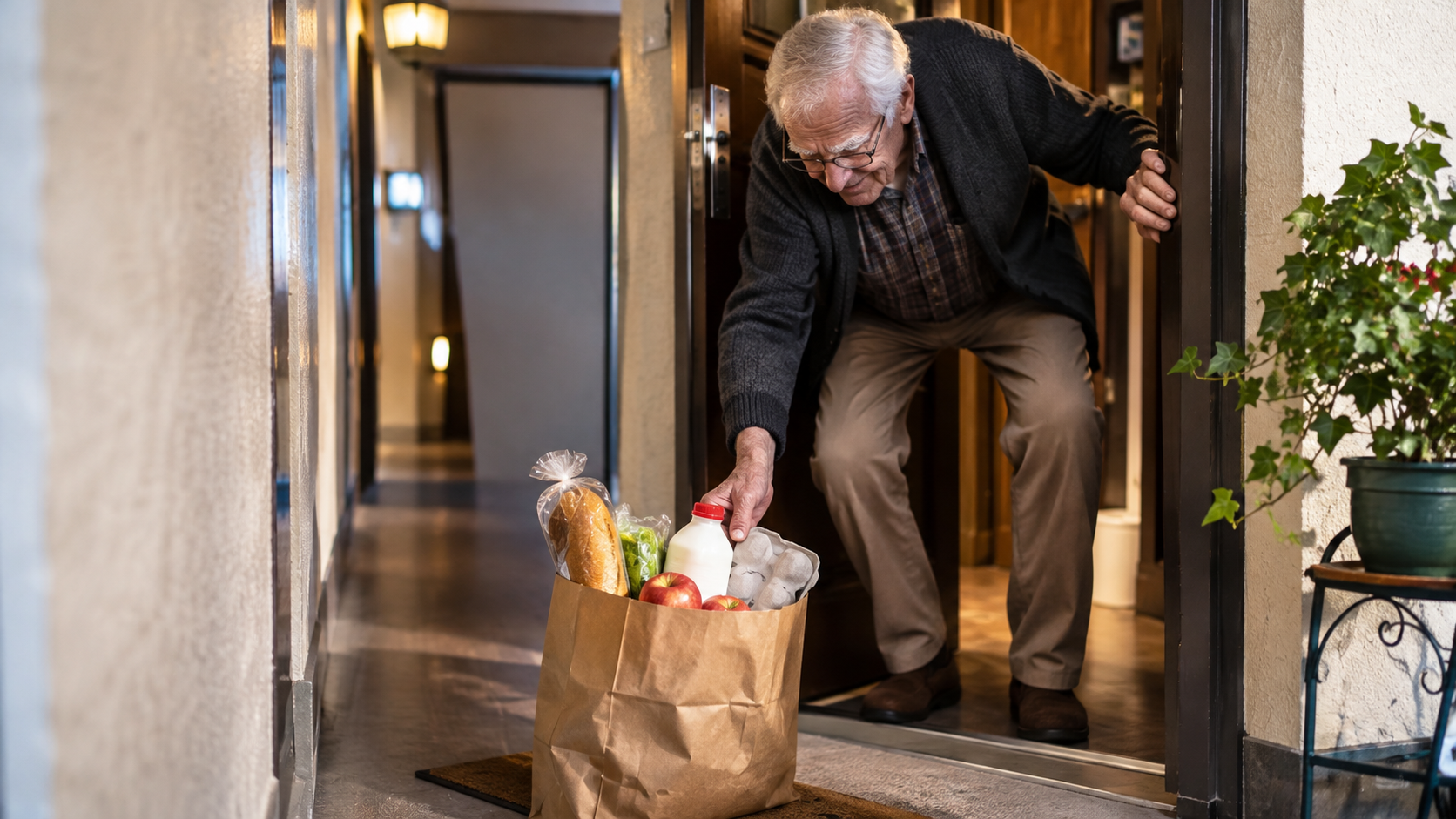
For almost eight months, someone had been leaving groceries outside apartment 3B every Sunday morning.
A carton of milk. A loaf of bread. Sometimes eggs, apples, or a small packet of biscuits.
The deliveries always arrived before seven.
And nobody ever knocked.
Seventy-four-year-old Walter Hayes had spent months trying to figure out who was responsible. He had asked the building manager, questioned the mail carrier, and even waited beside his window one Sunday morning.
But the mysterious visitor always seemed to arrive when he wasn’t looking.
Then, one rainy Sunday in November, Walter opened his door and discovered something different.
The groceries were gone.
In their place sat a small paper bag containing a handwritten note.
And the words inside made him sit down before he could finish reading.
The Quiet Man in Apartment 3B
Walter had lived in the same apartment building for twenty-three years.
His wife, Eleanor, had died four years earlier, and their only daughter lived several states away.
Before Eleanor passed away, their apartment had always been full of noise.
She played old jazz records while cooking, talked to the plants on the windowsill, and insisted on inviting neighbors over for coffee even when Walter complained that the place was too small.
After her death, the apartment became painfully quiet.
Walter still woke at six every morning. He made coffee, read the newspaper, and watered the plants Eleanor had left behind.
But he rarely went anywhere.
His knees had become unreliable, and the nearest grocery store was a fifteen-minute walk away.
Some weeks, he managed the trip.
Other weeks, he ate whatever remained in his cupboards.
He never told his daughter.
She already worried enough.
The First Grocery Bag
The first bag appeared on a Sunday in March.
Walter found it sitting neatly beside his welcome mat.
Inside were bread, milk, two bananas, and a packet of oatmeal.
There was no receipt and no note.
He assumed someone had delivered it to the wrong apartment.
He carried the bag downstairs and asked the building manager, Mrs. Collins, whether anyone had reported missing groceries.
Nobody had.
“Maybe somebody’s looking out for you,” she suggested.
Walter frowned.
“I don’t need charity.”
Mrs. Collins shrugged.
“Then call it a neighborly gesture.”
Walter took the groceries upstairs.
The following Sunday, another bag appeared.
Then another.
By April, it had become a weekly routine.
The contents were never expensive, but they were always useful.
One week, the bag contained a jar of peanut butter and the exact brand of strawberry jam Eleanor used to buy.
Walter stood in his kitchen holding the jar for a long time.
He hadn’t tasted that jam in years.
The Neighbor Across the Hall
Across from Walter lived a young woman named Sophie Miller.
She was twenty-nine, worked long shifts at a local hospital, and had moved into the building the previous winter.
Walter knew very little about her.
He knew she wore blue scrubs, sometimes came home after midnight, and owned a small orange cat that occasionally escaped into the hallway.
Their conversations rarely lasted more than a minute.
“Morning, Mr. Hayes.”
“Morning.”
“Beautiful weather.”
“Supposed to rain.”
And that was usually the end of it.
One afternoon, Sophie knocked on Walter’s door because her cat had disappeared again.
Walter found the animal sleeping beneath his dining table.
“He’s getting comfortable here,” Sophie said, laughing as she picked him up.
Walter almost smiled.
“He doesn’t talk much. I appreciate that.”
Sophie laughed again.
Before leaving, she noticed the photograph on the hallway table.
It showed Walter and Eleanor standing beside a lake.
“Your wife?” she asked.
Walter nodded.
“Her name was Eleanor.”
“She looks lovely.”
“She was.”
Sophie didn’t ask any more questions.
Walter appreciated that, too.
The Sunday Everything Changed
In early November, Walter developed a bad cold.
He spent most of Saturday in bed, drinking tea and listening to rain against the windows.
By Sunday morning, he felt slightly better.
At seven, he opened his apartment door expecting the familiar grocery bag.
Instead, he found a smaller brown paper bag.
Inside was a container of homemade chicken soup, a packet of tissues, and a folded letter.
Walter recognized the handwriting immediately.
It was Eleanor’s.
Or at least, it looked so much like hers that his hands began to shake.
He unfolded the paper.
Dear Walter,
If you’re reading this, I hope someone has finally convinced you that accepting kindness doesn’t make you weak.
Walter lowered himself into the chair beside the door.
The letter continued.
You spent forty years taking care of everyone around you. You fixed the neighbors’ broken shelves, carried groceries for people who couldn’t manage the stairs, and pretended not to notice when someone needed help.
But you were never very good at letting people help you.
Promise me that when someone offers, you’ll let them.
Love, Eleanor.
Walter read the letter three times.
Then he noticed a second piece of paper beneath it.
This one was written in unfamiliar handwriting.
Mr. Hayes,
I hope you don’t mind that I borrowed these words.
My grandmother kept this letter for years. She said your wife gave it to her after you helped my grandparents when they first moved into the building.
I thought you should have it back.
And I thought it was time you knew who has been leaving the groceries.
— Sophie
A Kindness That Had Waited Twenty Years
Walter stared at the name.
Sophie?
He looked across the hallway at apartment 3A.
Then he remembered something.
Twenty years earlier, a young couple had moved into the building with a little girl.
The husband had lost his job shortly after they arrived.
Walter had noticed the man carrying home bags from the discount grocery store, carefully counting coins before buying anything.
One December evening, Eleanor had suggested they leave a few groceries outside the family’s door.
Walter had objected.
“They’ll think we’re interfering.”
“Then don’t put our names on it,” Eleanor replied.
So they hadn’t.
For almost six months, they left small grocery bags outside the family’s apartment.
Eventually, the husband found work, and the deliveries stopped.
Walter hadn’t thought about that family in years.
Until now.
He crossed the hallway and knocked on Sophie’s door.
She answered wearing an oversized sweater, her orange cat winding around her ankles.
“Mr. Hayes?”
Walter held up the letter.
“Your grandparents lived here?”
Sophie nodded.
“Apartment 2C. A long time ago.”
“And the little girl?”
“My mother.”
Walter leaned against the doorframe.
Sophie stepped aside.
“Would you like to come in?”
The Story Sophie Had Grown Up Hearing
Sophie made tea while Walter sat at her kitchen table.
“My grandmother told me about you and Mrs. Hayes all the time,” she said.
“She said there was a winter when they didn’t know how they were going to afford groceries.”
Walter looked down at his hands.
“We didn’t do much.”
“She said it meant everything.”
Sophie placed a mug in front of him.
“When I moved into this building, Grandma recognized your name on the mailboxes. She told me you still lived here.”
Walter looked surprised.
“Your grandmother is still alive?”
Sophie smiled.
“Very much so. She’s eighty-six and still tells everyone what to do.”
Walter laughed for the first time that morning.
“Sounds familiar.”
Sophie continued.
“She told me that if I ever had the chance to return the kindness, I should.”
“So you’ve been buying the groceries?”
Sophie nodded.
“I noticed you sometimes struggled with the stairs. I didn’t want to embarrass you by offering help directly.”
Walter looked toward the window.
“And Eleanor’s letter?”
“Grandma found it in a box of old photographs. She said Mrs. Hayes wrote it for you years ago, but gave it to her for safekeeping because she thought you wouldn’t listen to her advice.”
Walter smiled through tears.
“That sounds exactly like Eleanor.”
The Invitation
For a while, they sat quietly.
Then Walter cleared his throat.
“Miss Miller?”
“Sophie, please.”
“Would you like to have dinner with me next Sunday?”
She looked surprised.
“I’d love to.”
“I should warn you, I’m not much of a cook.”
“That’s all right. I am.”
Walter considered this.
“Then I’ll provide the biscuits.”
Sophie grinned.
“Deal.”
The following Sunday, there was no grocery bag outside apartment 3B.
Instead, Walter opened his door at six-thirty and walked across the hallway carrying a small plate of homemade biscuits.
They were slightly burned.
He had made them himself.
Sophie opened the door, and the orange cat immediately slipped past her into the hallway.
Walter looked down at the animal.
“Well,” he said, “I suppose you’re invited too.”
A Different Kind of Sunday
By Christmas, Walter had become a regular guest at Sophie’s dinner table.
Sometimes her grandmother joined them.
Other times, Walter invited everyone to his apartment, where Eleanor’s old jazz records played again for the first time in years.
His daughter visited over the holidays and was surprised to find her father laughing in the kitchen with people she’d never met.
Later that evening, she asked him what had changed.
Walter looked toward the dining room, where Sophie was helping her grandmother arrange dessert plates.
“Your mother used to say kindness has a way of finding its way home,” he replied.
His daughter smiled.
“And you finally believe her?”
Walter glanced at the handwritten letter now framed beside Eleanor’s photograph.
“I think I’m beginning to.”
The groceries had stopped arriving every Sunday.
But Walter no longer needed to open his door to find proof that someone cared.
Now, whenever he heard a knock, he knew there was a good chance it was someone coming to share a meal, borrow a book, or simply ask how his day had been.
And after four years of silence, that was more than enough.
Sometimes the kindness we give away returns years later, carried by someone we never expected to meet.