My brothers inherited our father’s house, his savings, and almost everything he owned.
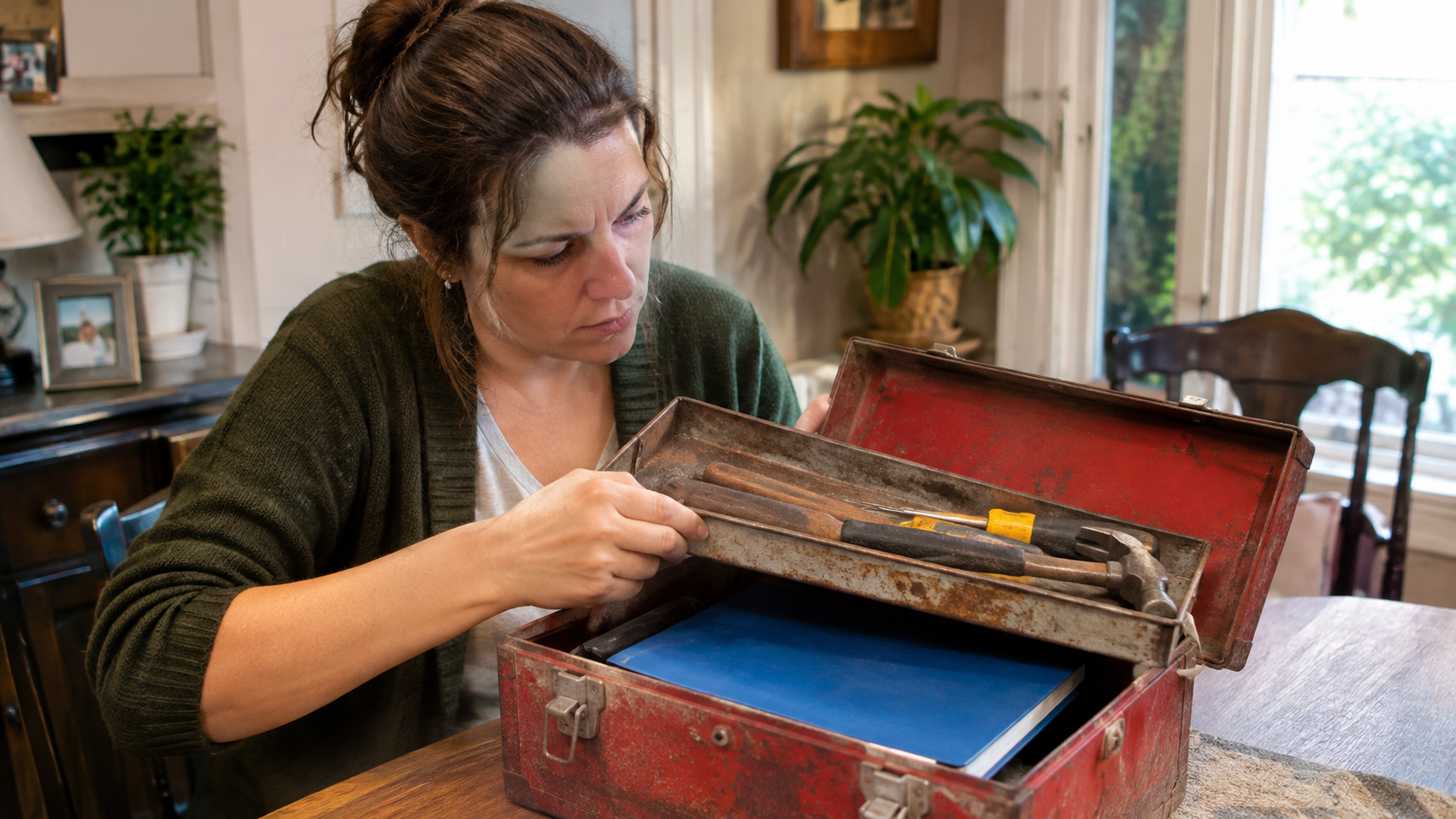
I received a rusty red toolbox.
At first, I thought there had been a mistake.
My father had spent forty-two years working as a carpenter. He owned a modest house, a pickup truck, and enough savings to leave something meaningful to each of his three children.
But when the lawyer read his will, my older brothers, Daniel and Eric, were given nearly everything.
And I was handed a toolbox that looked as though it belonged in a junkyard.
Daniel actually laughed.
“Well, Sarah,” he said, leaning back in his chair, “I guess Dad wanted you to learn how to fix things.”
Eric smirked.
I stared at the box sitting on the lawyer’s desk.
It was scratched, dented, and covered in old paint.
Then the lawyer handed me a small envelope.
“Your father left you a letter,” he said. “He specifically requested that you read it at home.”
I slipped it into my purse.
I had no idea that the contents of that toolbox would eventually force my brothers to confront something they’d spent years ignoring.
The Daughter Who Stayed
My father, Thomas Miller, wasn’t an easy man.
He rarely talked about his feelings. He believed most problems could be solved with hard work, patience, and a decent set of tools.
When I was little, he taught me how to repair a broken chair before he taught me how to ride a bicycle.
“Things don’t always need replacing, Sarah,” he’d say. “Sometimes they just need someone willing to put in the effort.”
My brothers never shared his enthusiasm for fixing things.
Daniel became a financial adviser and moved two hours away.
Eric started a construction supply business in another city.
I became a nurse and stayed close to home.
After Mom died, Dad lived alone for several years.
Then his health began to decline.
At seventy-six, he developed a heart condition that made ordinary tasks increasingly difficult.
He could no longer mow the lawn or carry heavy groceries. Some mornings, even walking from his bedroom to the kitchen left him exhausted.
I started stopping by after my hospital shifts.
At first, it was just to bring dinner.
Then I began managing his medications, taking him to appointments, cleaning the house, and helping him pay bills.
Eventually, I moved into the small guest room.
I told myself it was temporary.
I stayed for four years.
The Brothers Who Visited on Holidays
Daniel and Eric weren’t cruel people.
They called on birthdays and sent expensive gifts at Christmas.
But whenever I asked them to help with Dad, they always had a reason they couldn’t.
Daniel was busy with clients.
Eric had employees depending on him.
Once, when Dad was hospitalized for three days, I called Daniel and asked whether he could come.
“Is it serious?” he asked.
“Serious enough that he’s in the hospital.”
He sighed.
“Sarah, I can’t just abandon work every time something happens.”
I didn’t argue.
I was too tired.
When Dad came home, he asked whether his sons had visited.
I told him they had been busy.
He nodded and looked out the window.
He never complained.
But I noticed that he stopped asking about their visits after that.
The Day We Said Goodbye
Dad died quietly on a Tuesday morning in February.
I was sitting beside his bed when it happened.
His hand was warm in mine.
Just before he passed, he opened his eyes and whispered something I almost didn’t hear.
“Don’t forget the red box.”
I assumed he was confused.
He’d been talking about old projects and people who had died years earlier.
I kissed his forehead.
“I won’t, Dad.”
Then he closed his eyes.
Those were his last words to me.
The Will That Changed Everything
Two weeks after the funeral, we gathered at the lawyer’s office.
Daniel arrived in an expensive suit.
Eric spent most of the meeting checking messages on his phone.
I sat quietly, still struggling to believe Dad was gone.
The lawyer began reading.
The house would be divided equally between Daniel and Eric.
Dad’s savings would also go to them.
His truck would be sold, with the proceeds added to the estate.
Then the lawyer reached my name.
“To my daughter, Sarah Miller, I leave my red toolbox and everything contained within it.”
There was silence.
Then Daniel chuckled.
“That’s it?”
The lawyer looked up.
“Those are your father’s instructions.”
Eric shook his head.
“Well, that’s awkward.”
I felt my face grow hot.
For four years, I’d rearranged my life around Dad’s needs.
I’d missed holidays, turned down promotions, and spent countless nights sleeping in a chair beside his bed.
And he’d left me a box of old tools.
I didn’t care about the money.
At least, that’s what I kept telling myself.
But I couldn’t pretend it didn’t hurt.
The Letter I Almost Threw Away
That evening, I carried the toolbox into my apartment.
It was heavier than I expected.
I placed it on the kitchen table and opened the envelope from the lawyer.
Inside was a single sheet of paper.
Dad’s handwriting was uneven, but unmistakable.
Sarah,
I know you probably have questions.
You have spent years taking care of me, and I know how much you gave up.
Your brothers have their own lives, and I made my decisions about the estate for reasons I explained to the lawyer.
But there is something in this toolbox that belongs to you.
Look beneath the bottom tray.
And please remember what I taught you when you were little.
Love, Dad.
I stared at the letter.
Then I opened the toolbox.
The top tray held familiar things.
A tape measure. A carpenter’s pencil. Several screwdrivers. A small hammer with a worn wooden handle.
I remembered using that hammer when I was nine.
Dad had helped me build a crooked birdhouse for a school project.
I lifted out the tray.
Beneath it were old bolts, sandpaper, and a folded cloth.
I removed everything.
At the bottom was a thin wooden panel.
One corner had a small notch.
I slipped my finger underneath and lifted it.
And there, hidden inside a shallow compartment, was a blue folder.
The Secret Beneath the Tools
The folder contained documents.
At first, I couldn’t understand what I was looking at.
There were bank statements, legal papers, and a handwritten list of dates.
Then I saw my name.
Sarah Miller — Beneficiary.
I sat down.
The documents described a trust Dad had established three years earlier.
Its assets included an investment account and a small rental property on the other side of town.
I knew the property.
Dad had purchased it decades ago and rented it to the same family for years.
I’d assumed he sold it after his health declined.
But he hadn’t.
According to the paperwork, the property had been transferred into the trust, and I was its sole beneficiary.
The investment account contained money Dad had saved over many years.
I checked the figures twice.
Then I called the lawyer.
“Mr. Harris, I found some documents in Dad’s toolbox.”
“I was expecting your call,” he replied.
“Are these real?”
“Yes.”
“Why didn’t you mention them at the will reading?”
“Because the trust is separate from your father’s estate. He wanted you to discover the documents yourself, then contact me.”
I looked at the papers spread across my kitchen table.
“Why?”
Mr. Harris was quiet for a moment.
“Your father said you would understand when you read the rest of his letter.”
I frowned.
“There isn’t anything else.”
“Check the folder, Sarah.”
The Second Letter
Behind the legal documents was another envelope.
This one had been sealed.
I opened it carefully.
My dear Sarah,
You once told me you wanted to buy a little house with a garden.
You said you wanted somewhere quiet after long hospital shifts, with enough room for a dog and a kitchen big enough to bake in.
I remember.
I also remember the day you turned down that nursing position because you were worried about leaving me alone.
You never told me you regretted it, but I knew what it cost you.
Your brothers have always been good at asking for what they want. You have always been better at noticing what other people need.
I don’t want you to spend the rest of your life believing your needs matter less.
The property and savings in the trust are yours. You can keep them, sell them, or use them however you choose.
I have also left instructions with Mr. Harris to explain everything.
And Sarah, please don’t mistake this for payment.
You cannot put a price on the years you gave me.
This is simply a father trying, in the only way he knows how, to help his daughter build the life she deserves.
Love always, Dad.
I read the letter once.
Then again.
By the third time, the words had blurred.
For years, I’d believed Dad barely noticed the things I did for him.
He rarely thanked me.
He never asked what I was sacrificing.
But he’d been paying attention all along.
When My Brothers Found Out
The trust paperwork wasn’t a secret for long.
A month later, Daniel called after learning that Dad’s rental property had not been included in the estate.
“Did you know about this?” he demanded.
“Not until after the will reading.”
“That property is worth a lot of money, Sarah.”
“I know.”
“And Dad left it to you?”
“Yes.”
There was a long silence.
Then Daniel said something that surprised me.
“Why?”
I thought about answering with anger.
I could have reminded him of every missed appointment and every holiday I’d spent caring for Dad while he and Eric were away.
Instead, I told him the truth.
“I think Dad wanted me to have a chance to start over.”
Daniel didn’t respond.
Two days later, Eric came to see me.
He asked to read Dad’s letter.
I let him.
When he finished, he sat quietly at my kitchen table.
“I didn’t realize you gave up that job,” he said.
“I didn’t tell you.”
“You shouldn’t have had to.”
I looked at him.
For once, he didn’t have an excuse.
“I’m sorry, Sarah,” he said.
It wasn’t a dramatic apology.
There were no tears or grand speeches.
But it was the first time either of my brothers had acknowledged what those four years had been like.
And it mattered.
The House With the Garden
Six months later, I sold the rental property.
After reviewing my finances and speaking with an adviser, I used part of the proceeds to purchase a small house near the hospital.
It had two bedrooms, a sunny kitchen, and a garden filled with overgrown roses.
The first weekend after moving in, I found Dad’s toolbox in a stack of unopened boxes.
I carried it into the backyard.
One of the wooden garden benches had a loose leg.
I opened the toolbox, found the old hammer, and began working.
Halfway through the repair, I remembered something Dad used to say.
“Don’t rush, Sarah. A good repair takes patience.”
I smiled.
Then I kept working.
That afternoon, Daniel and Eric arrived with sandwiches and a tray of flowers for the garden.
Eric looked at the bench.
“Need a hand?”
I glanced at him.
“Actually, yes.”
He picked up a screwdriver.
Daniel carried the flowers toward the porch.
For the first time in years, the three of us spent an afternoon working together without arguing.
Dad would have liked that.
What I Finally Understood
The toolbox still sits in my garage.
I use it whenever something needs fixing.
Sometimes I open it just to see the worn wooden handle of Dad’s hammer or the carpenter’s pencil he sharpened with a pocketknife.
The trust helped me buy a home.
But the toolbox gave me something else.
It reminded me that my father had seen more than he knew how to say.
And although his decisions about the estate were complicated, I no longer measured his love by what happened in the lawyer’s office.
I measured it by the years we spent together.
By the birdhouse we built when I was nine.
By the quiet mornings when I brought him coffee.
And by the last thing he asked me to remember.
Sometimes the most valuable thing someone leaves behind isn’t the inheritance itself, but the proof that they understood what you gave.